By Will Rietveld
Introduction
I don’t always fish on wilderness trips in the mountains,
partly because my “ultralight” fishing gear, consisting of a lightweight and
compact spinning rod and reel and 2-3 lures, weighs 10 ounces, which is significant.
It really works well to catch and release trout in alpine lakes. However, for
me, fishing is optional, and fishing gear adds weight to my pack.
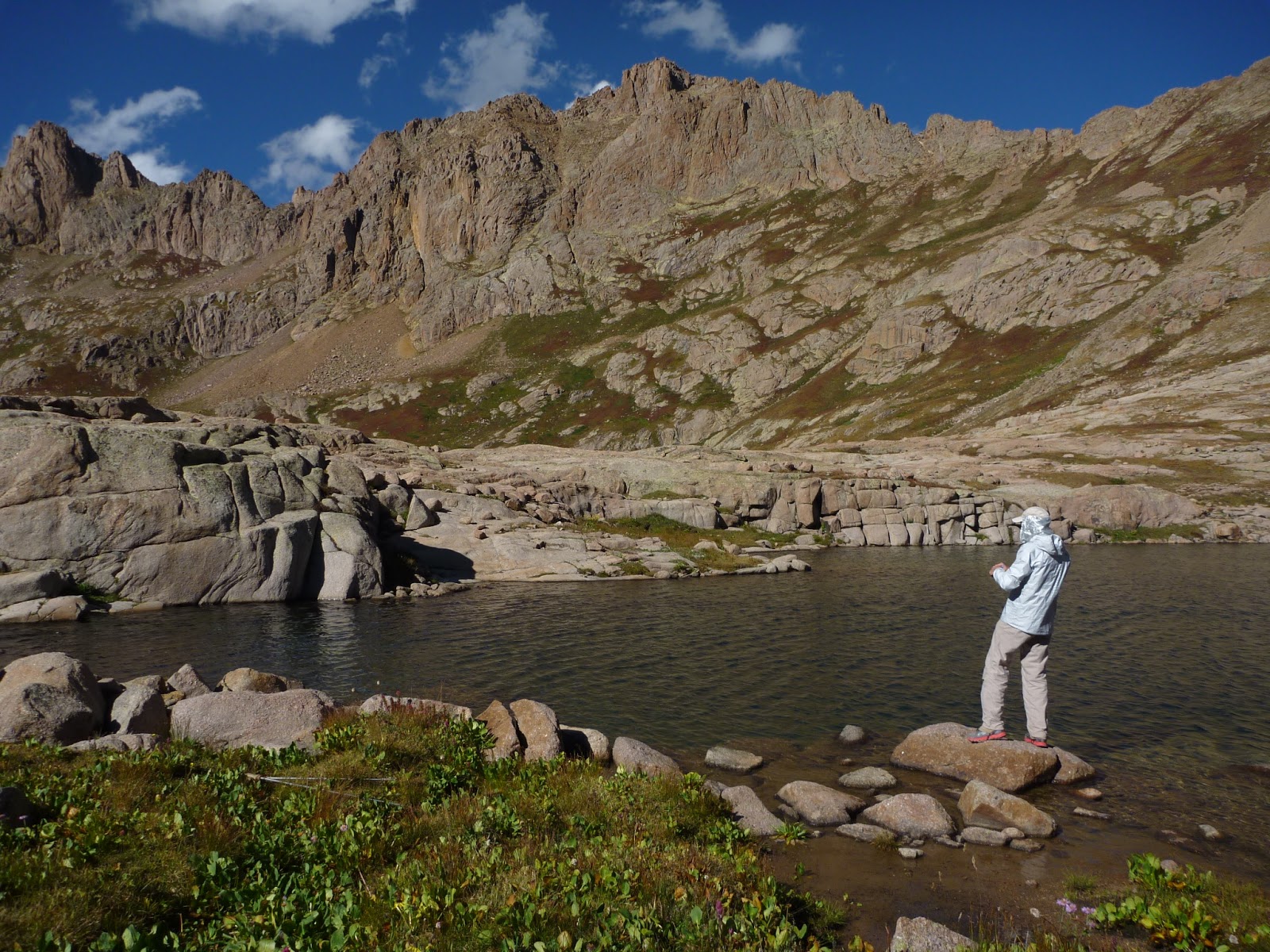 |
| Fly fishing with my 1.6 ounce handline system at an alpine lake. |
Enter the handline. I didn’t invent it; Rik Christensen did that (read his article “Ultralight Tic Tac Fishing Kit” on the Gossamer Gear Blog). His kit consists of a plastic Tic Tac mint container with fishing line wrapped around it and a few spinning lures inside. He doesn’t give the weight, but it’s obviously very light.
I first met the Tic Tac handline when Glen Van Peski (Gossamer Gear founder and Master of UL backpacking) joined me on three backpacking trips in my backyard, the Weminuche
Wilderness in southern Colorado .
On the first trip I caught lots of fish with my spinning outfit, but Glen had
little success with his handline, so we took turns catching fish with the
spinning rod. However, on our most recent trip Glen was catching fish with the
handline; he had mastered the technique. That opened my eyes, and my mind.
I reasoned that it is difficult to retrieve fast enough
with a handline to keep the lure from snagging the bottom, so using a handline
with a spinning lure is challenging. My aha! moment was when I realized that
the handline might work much better with a fly
and bubble, because the bubble and fly float on the surface.
 |
| Success; I found a bubble and a fly works better on a handline (for trout at least) than a spinning lure. The bubble and fly float on the surface while being retrieved, while a spinning lure sinks to the bottom where it can easily become snagged. |
In this article I describe my own version of an ultralight handline for fishing on wilderness backpacking trips, and how to clean and cook fish without the need for any special cutlery or cookware.
The Handline System
 |
| This is my version of an ultralight handline. It consists of a round plastic 50 milliliter mini liquor bottle, 50-75 feet of 6 pound fishing line wrapped around it, a mini fly fishing bubble, and a few dry flies with leaders. The bubble and flies are stored inside the bottle. |
 |
| The complete system weighs 1.6 ounces, including the stuff sack. A small plastic bag would work just as well as a storage bag. |
Finding a mini liquor bottle is easy; empty ones are usually readily available along the roadside, or purchase a full one at any liquor store.
Making the handline is easy:
- Remove the bottom from the plastic bottle, and discard the cap.
- Tie the fishing line around the neck of the bottle and tape it down.
- Wrap 50-75 feet of fishing line (I use 6# line) around the outside of the bottle, and hold it in place with a strip of painter’s (blue or green) masking tape.
- Thread the other end of the fishing line through the bubble and then tie on a mini swivel.
- Select 2-3 popular artificial fishing flies for your locale and tie a 4-foot long leader on each one, then tie a loop at the other end. It helps to wind the fly and line on a small piece of lightweight foam as shown.
- Store the bubble and flies inside the plastic bottle.
- A tiny stuff sack is handy to contain the handline, but a small plastic bag will work just as well.
The fishing technique is also easy:
- Attach a fly to the swivel.
- Fill the bubble about 2/3 full of water to provide weight for casting.
- Remove the painter’s tape holding the line in place and pull off about 2-3 feet of line above the bubble.
- Holding the bottle in one hand, fling the bubble and fly out with the other hand (this takes a little practice).
- Slowly retrieve the line by wrapping it around the bottle while carefully watching the fly beyond the bubble.
- When you see a swirl at the fly, pull on the line to hook the fish.
- Pull in the fish. It’s hard to maintain tension on the fish by winding the line around the bottle, so you may need to put the bottle in a pocket and pull the line in hand over hand.
Cleaning Fish
 |
| Most backpackers carry some kind of folding knife or multi-tool for whatever need that comes up, including cleaning fish. However, from an ultralight backpacker’s viewpoint, a conventional knife is overkill and extra weight. I use a simple single-edged razor blade. That’s all I need; it’s cheap and ultralight (0.1 ounce). |
 |
| To prepare fish for cooking I gut the fish, cut off the head and tail, and then cut up the fish into pieces about 3 inches long. Another type of lightweight knife is shown in the photo. |
Cooking Fish on an Alcohol Stove (or any cooking system)
I avoid starting a fire to cook fish or bringing a frying
pan to cook fish because I don’t want the extra weight or environmental
impacts.
 |
| My method is to simply poach the fish in my cook pot. In my case that’s a Trail Designs Caldera Keg-F cooking system (which uses a 25.4 ounce Foster’s beer can for the cook pot), or more recently a Gossamer Gear GVP Ultralight Stove System (shown, which uses a shortened version of the same pot). |
Again, the method is very simple:
- Put sections of fish in the pot, leaving at least 2 inches at the top.
- Fill the pot with water to cover the fish about 1 inch. Put the lid on the pot.
- Fill the stove’s burner with enough alcohol to heat the fish plus water to boiling.
- Start the stove and bring the water to boiling.
- Leave the fish in the hot water about 10 minutes (this is the “boil and set” method I use for all of my camp cooking).
- Drain the water and take the fish to a nice clean rock to serve as a plate.
- Eat and enjoy the scenery.
 |
| Another view of the Gossamer Gear GVP Ultralight Stove System, which is about 3 ounces lighter than the Trail Designs Caldera Keg-F system. It uses a smaller more fuel-efficient burner, shorter cone, and shortened cook pot. The minimum weight of the Gossamer Gear cooking system, including an insulated cozy/carry bag is just 2.9 ounces. I will publish a review on the Gossamer Gear system in the near future. |
Conclusions
Catching a fish for dinner is a fun activity at a wilderness
camp, and it doesn’t need to add weight to your pack and complexity to your
trip. This overall technique makes
catching fish and eating them as simple and lightweight as possible.
Taking fishing gear on a backpacking trip is no longer a
decision involving a weight penalty; now I include the handline as part of my
basic kit, and it only adds 1.6 ounces.
Overall my new fish catching, cleaning, and cooking gear, as
described (a handline for catching fish, a single-edged razor blade for
cleaning fish, and the new Gossamer Gear GVP Ultralight Stove System for
cooking fish), has reduced my base weight by 11 ounces compared to my previous
system. That’s a lot.
Handline fishing works well for catching dinner, but it is a
bit tedious for sport fishing.
